For anyone who does not want to leave unprepared

Emigrating is an adventure. Your finances need not be.

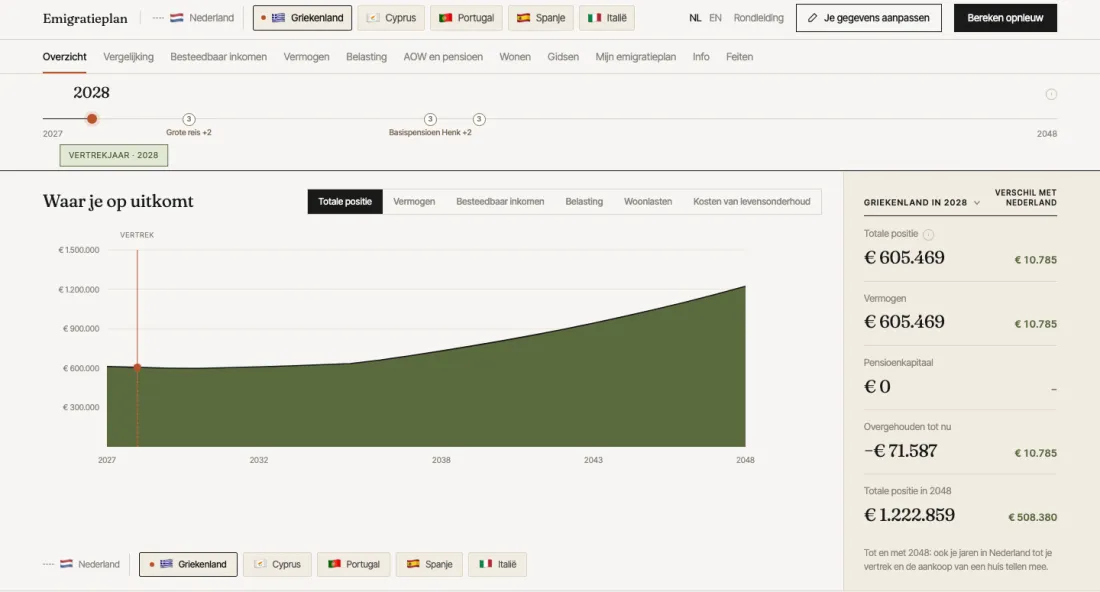
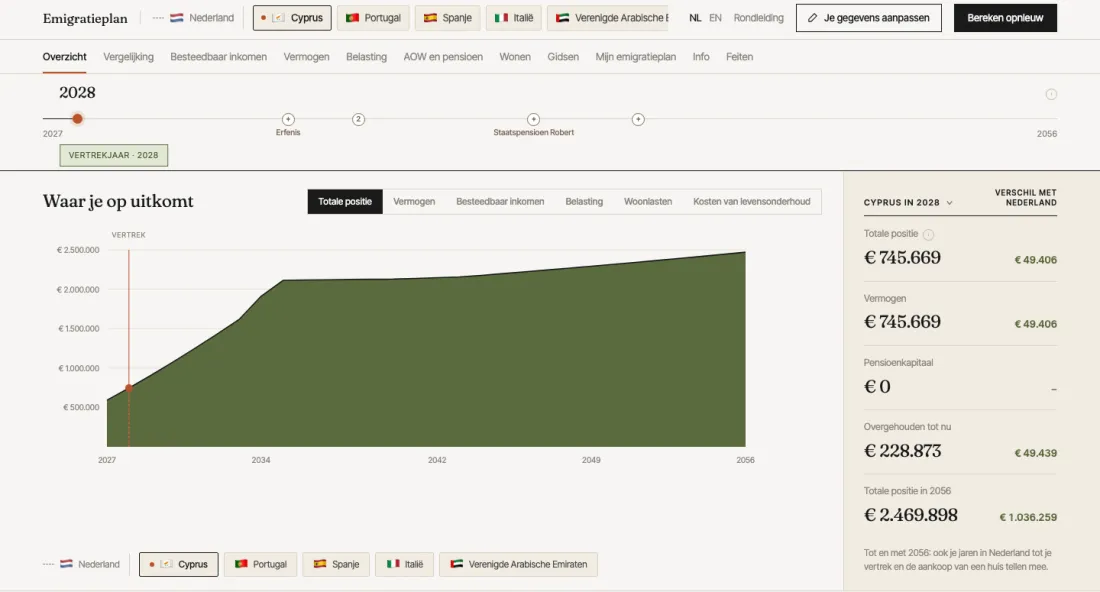
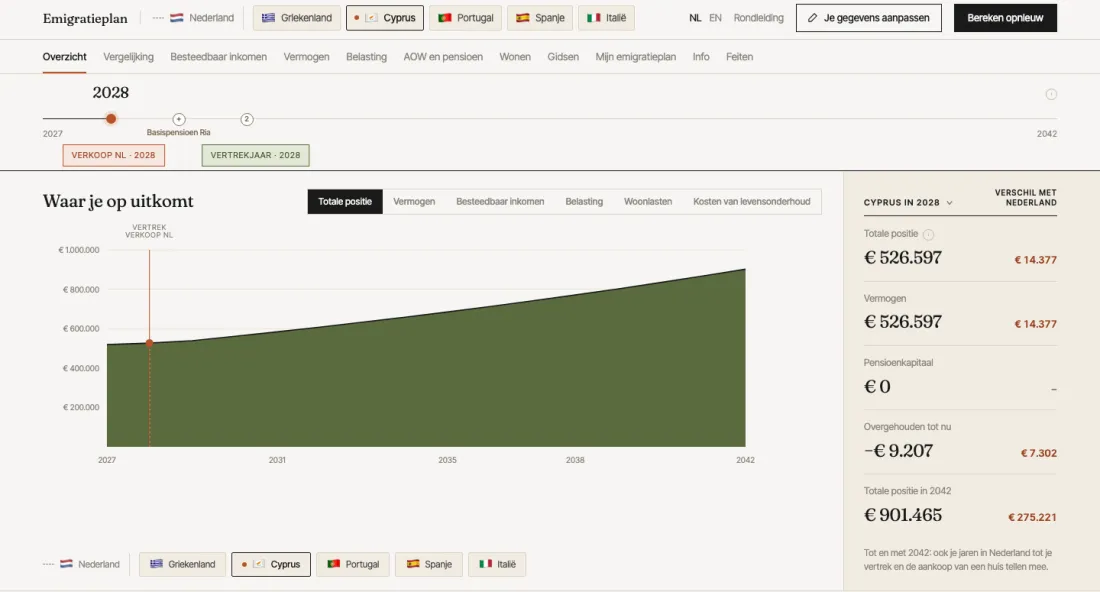
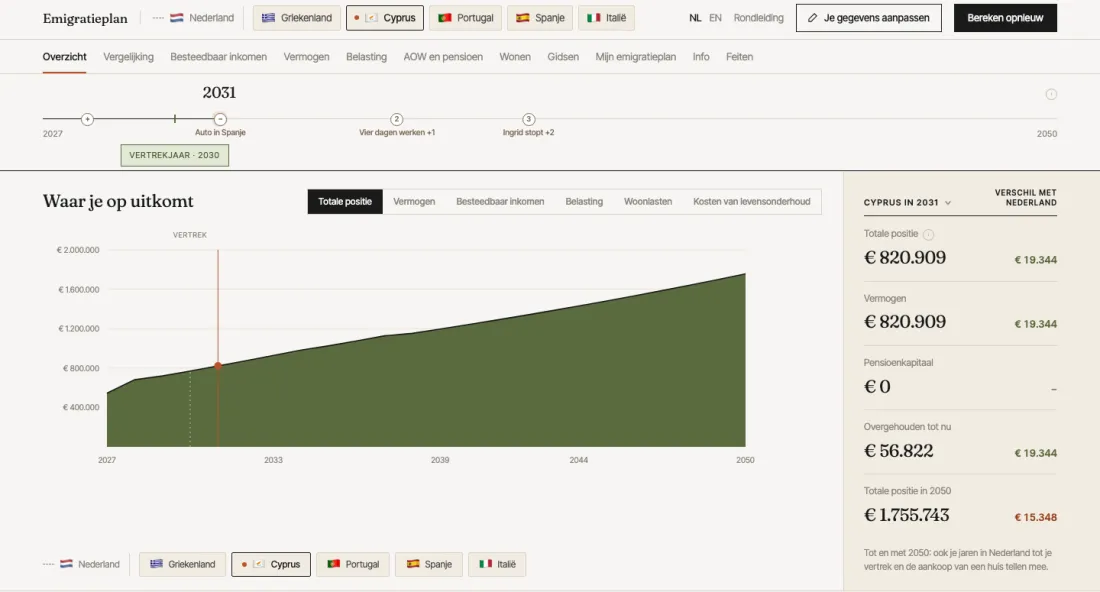
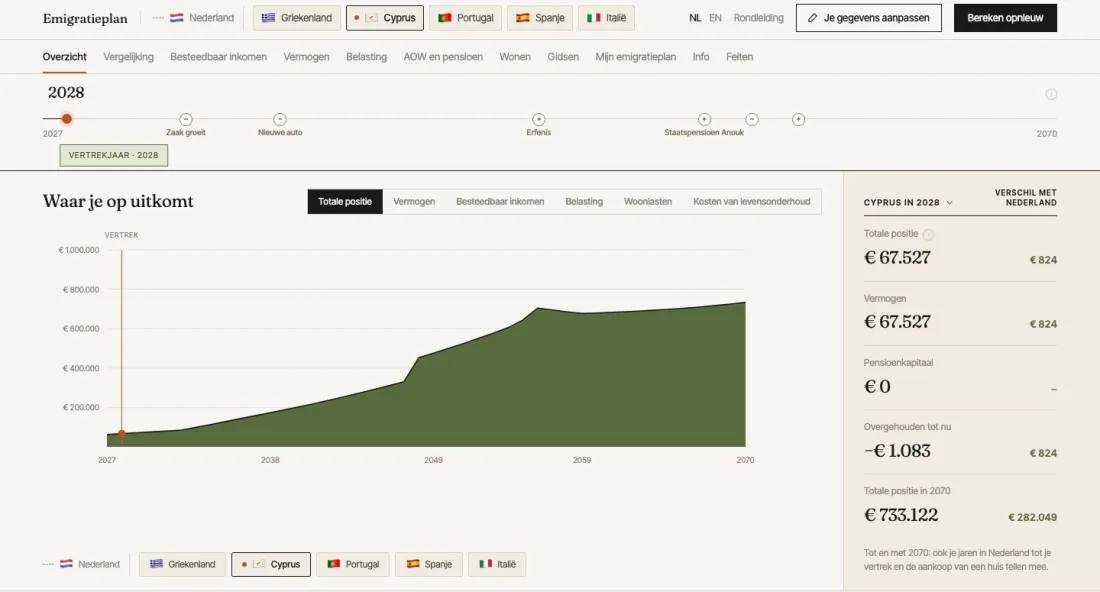
Put your life here, next to your life there. You see year by year whether you come out ahead or behind, by how much, and from when. With your own figures, up to and including your pension, for five countries of your choice alongside the Netherlands.

One-off purchase from €219.
Without a subscription, with .

From dream to plan

The sun. Peace and quiet. A business of your own. A life at a slower pace. Money is rarely the only reason to go. Still, you want to see what your move means, before you sell your house and hand in your notice.

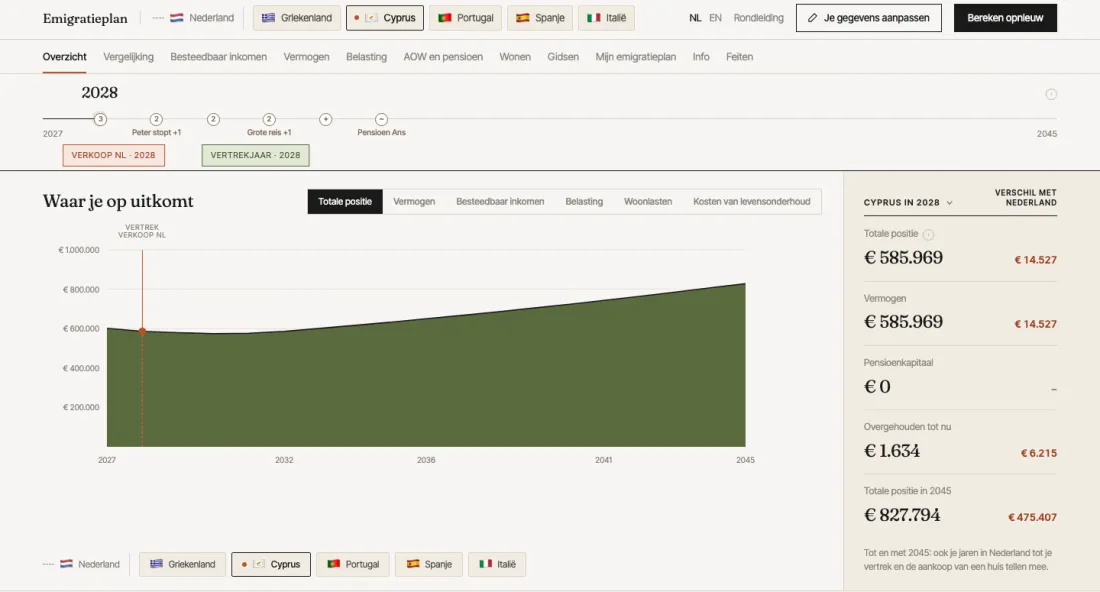
Peter and Ans

63 and 61. Stopping in 2028 and selling their house.

Compared with staying in the Netherlands, in 2045 i

See Peter and Ans in the demo

Read what matters in this plan
What matters in this plan
Now Move AOW age 50 years
Your last years in the Netherlands
What housing and living there cost
Which country taxes your pension
Your AOW build-up
stops when you move
Your pension, gross and net
Counts in the calculation every yearNot certain, depends on your situationMoment when something changesi

Your plan not listed? You enter your own situation and the tool works it out for you. On your own or together, employed, freelance, with a BV or a mix.

Small assumptions, big difference.

Emigrating touches your income, tax, assets and pension at the same time. If you do not run the numbers, you find out when it is too late.

Suppose your assumption is off by €400 a month.

Per month €400
Per year €4,800
Over 20 years €96,000▲▼

This is a worked example. Your difference depends on your income, assets, employment structure and country. That is why you run the numbers on your own situation, with your own figures.

Without a plan

You move your whole life. After five years you find out it works out differently financially than you thought. What now?

With Emigratieplan

You know before you leave. And you choose with your heart and with your head.

Run the numbers on my situation

Other tools: one year.
Emigratieplan: every year.

The tool calculates with income, tax, housing, pension and assets, for you and your partner. Before you leave and after, split per year, to compare across five countries alongside the Netherlands.

Apples with apples. Every country has its own taxes, rates and exceptions. Emigratieplan converts them all into one harmonised model. That way you put every country fairly next to every other country, and next to the Netherlands.
“I put Emigratieplan next to eighteen other tools, advisers and guides. Not one of them calculates year by year for you and your partner, in several countries at once and with the same rules.”
Kevin van Grondelle, founder
I built Emigratieplan for our own question: what does emigrating do to our lives financially, twenty or fifty years from now? No tool gave us a clear answer. So I built it myself, for everyone who is also wrestling with those numbers.
Kevin van Grondelle Kevin van Grondelle Founder and builder. Preparing my own emigration with my partner.

Four steps to an emigration that adds up

Working it out yourself was almost impossible. With Emigratieplan you now do step 2 yourself.

From five countries to one plan

  1. Line up your countries

    Which countries are an option at all? Think about climate, language, residency rights, the housing market and distance to family.

    Result: a list of usually around five countries that are serious options.

    You do this yourself
  2. Run the numbers and choose

    What does each country mean financially, across the whole period you want to live there? Good calculations take five countries back to one or two.

    Result: the countries that add up financially for the life you want.

    You do this with Emigratieplan
  3. Have it checked for tax

    One or two countries, concrete questions, focused hours with a tax adviser. You walk in with numbers and solid preparation.

    Result: confirmation of your plan and the points that need attention.

    A tax adviser does this
  4. Arrange it and leave

    Residence permit, the move, insurance, deregistering. With a plan you understand yourself.

    Result: a departure that goes the way you calculated it.

    An adviser does this

Example. Which countries they are for you, you decide.

Seven things you know once you have run the numbers

01In which year it changes for you

The difference with the Netherlands does not stand still. It changes when your pension starts, when your AOW gap starts to count, when your house is sold or your mortgage paid off, or when your business starts to run. If you have a special tax regime, the year it ends counts too. Emigratieplan calculates every year separately and shows per country how the scenario changes. Down to the year.

02What you actually keep, net

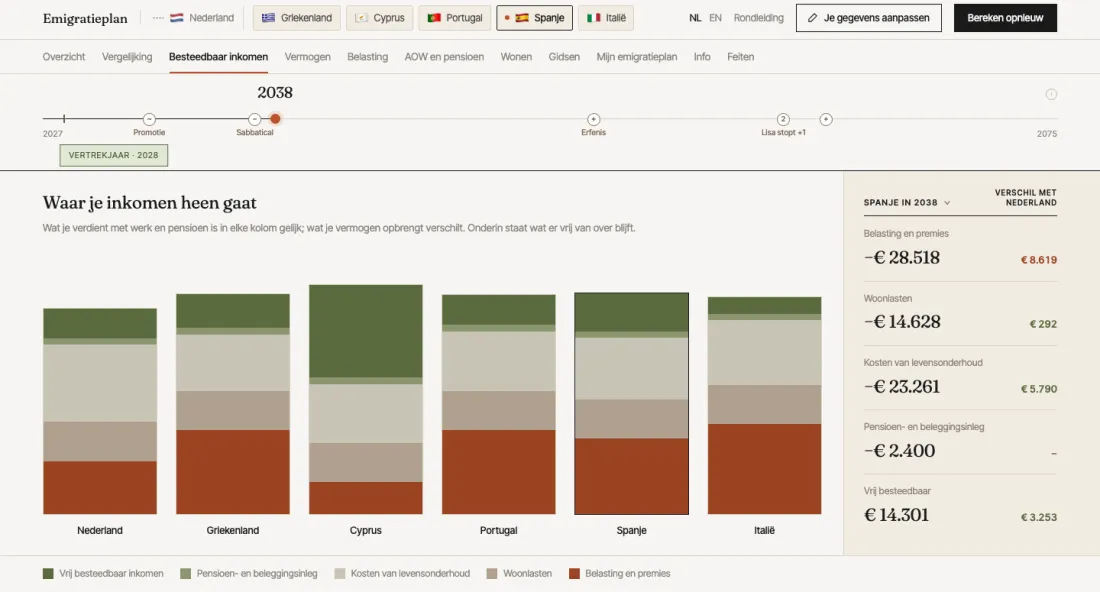
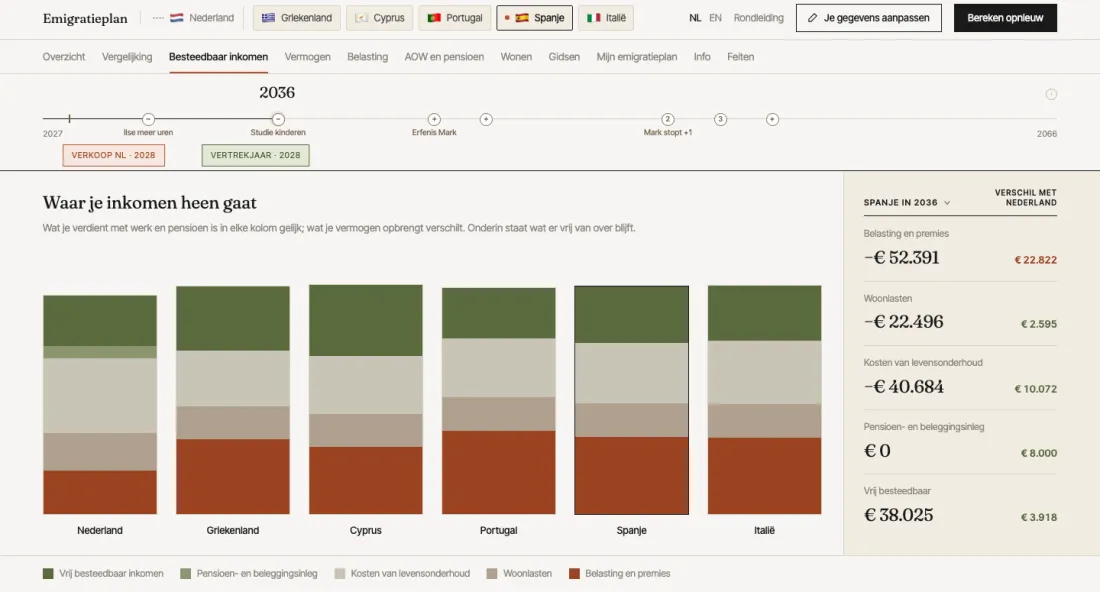
A lower tax rate says little on its own. Social contributions, compulsory health insurance, local levies and housing costs count just as heavily. You see the amount that is really left each year, with every item included, so you know where the difference comes from. And you see whether your money lasts until the end of your plan, or in which year it runs out.

03What happens to your pension and AOW

Two things that stand apart from each other. You see in euros what the end of your AOW build-up means for you.

On top of that, the tax treaty determines which country may tax your pension, and that differs per country and per type of pension. Both are calculated per country, so you can still change something about it before you leave.

When you leave, the Netherlands levies a protective assessment on the pension you have built up and on your annuity. You do not have to pay it straight away; it is collected if you, for example, cash in your pension. The tool makes a calculation for that too.

04The impact of your house and mortgage

For most people the choice between selling, keeping or renting out has the biggest impact on the balance. As soon as you deregister from the Netherlands, the tax treatment of your home and your mortgage interest relief changes.

In the new country other costs come on top: an annual tax on your home and costs when you buy. You see per country what buying, renting and renting out cost or deliver over your horizon, so you can make a well-considered choice.

05The big moments in your life

An inheritance, a gift to your children, working less, a big renovation or selling your investments. You place each moment in the year it happens, and the tool calculates what it does to your income and your assets. When you sell, that country's capital gains tax is added, in that one year. That way you see, for example, whether you are better off selling before or after you leave.

06What happens to your BV

Do you have a BV, a Dutch private limited company? Salary and dividend are calculated separately per country, and you see which split leaves the most net. Which split you choose is something to discuss with your adviser. It takes into account the minimum salary you have to take in that country, if that rule exists. And the protective assessment the Netherlands levies on your shares when you leave.

07Which variables really determine your outcome

Nobody knows inflation for sure. The choices you make yourself weigh much more: employment or your own company, buying or renting, when you leave, when your pension starts, which regime you qualify for. That handful of dials together determines most of your bottom line. The good news: they are in your own hands. In the tool you can calculate unlimited scenarios and see straight away what changes. That way you know what your scenario depends on before you put it into practice.

And only then to the tax adviser.

You do not hire an architect and say "just build something". You come in with a brief: square metres, budget, what the bank will finance, what the zoning plan allows. You do that homework up front.

At the tax adviser the opposite happens. People come in without worked-out scenarios, without concrete numbers, without specific questions. The first hours go to explaining their own situation and going through the basic rules of emigration, at around €120 to €230 an hour (an indication of usual rates). You do not need those hours if you walk in with a solid emigration plan.

Note: Emigratieplan does not replace a tax adviser. It makes sure you spend those hours on the questions that matter to you.

Where you stand once you have run the numbers. You see per country what your plan gains or costs you, and from which year the difference with the Netherlands turns. You go to one tax adviser with a few targeted questions. And you decide about your house with an amount in front of you.

You do not take out a mortgage without knowing your monthly payments. Emigrating affects your house, your mortgage, your income and your pension at the same time. That deserves at least the same preparation.

Reviews

The newest comes first. Test users were given the tool for free to test it, and that is shown with their review. I only publish reviews from people who used the tool themselves. Reviews are written in Dutch and translated automatically.

  • ★★★★★

    You understand what you are looking at

    The decision guides are excellent and make sure you do not get lost in the jungle of numbers but actually understand what you are looking at! The numbers gave me more insight into my finances and I am now also much more aware of the risks in my situation.

    PatriciaTest user ·
  • ★★★★★

    Calm, overview and confidence

    A clear and professional tool that translates the complex financial consequences into a straightforward, practical plan. You immediately get calm, overview and the confidence that you are not missing anything important.

    ArthurTest user ·
  • ★★★★★

    Definitely worth the money

    The tool really looks great, very clear and very comprehensive. I would definitely use it when I emigrate and I would also find it worth the money.

    MarkTest user ·

You bring the adventure. The tool does the maths.

One-off purchase, with lifetime access* to your version. Choose what fits your stage.

The sooner you run the numbers, the more you can still choose. When you leave, your AOW build-up stops and the Netherlands puts an assessment on your pension and your BV.

If your country is already fixed

Compare

The Netherlands + 1 country, year by year
€219 One-off

Pay securely via Stripe withiDEAL | WeroVisaMastercard

What is in each package

Below are the differences. Click a row for an explanation.

Feature Compare €219 Explore €279 Recommended start Decide €349
Countries
Calculations, per country
Comparing
Deciding
Saving and terms
Buy Compare Buy Decide
30-day money-back guarantee. Immediate access after payment. Pay securely via Stripe.

Not satisfied? Money back.

Run the numbers for a week, two weeks. Do you find the tool is not worth the money? Send one email to kevin@emigratieplan.nl and you get your money back. No questions, no forms, no phone calls.

What advisers say

Partner of EmigratieplanFiscaal naar Cyprus

★★★★★

Finally a tool that goes further than tax rates

At Fiscaal naar Cyprus we guide entrepreneurs from the Netherlands and Belgium who emigrate to Cyprus. I filled in Emigratieplan completely myself, and I am impressed by how complete it is.

Most comparisons stop at "which country has the lowest rate". Emigratieplan calculates your whole situation. Step by step you enter your household, income, home, assets, state pension (AOW) and pension, and your fixed costs. You then get a projection over several years of what you really keep, in the Netherlands and in the countries you compare.

Wytze HoekstraWytze Hoekstra, Fiscaal naar CyprusTranslated from Dutch.

Fiscaal naar Cyprus is a partner of Emigratieplan. If you become a client through me, I receive a fee for it. That changes nothing in the calculation.

Under the hood

What the tool calculates, and where every number comes from.

Sources

2,500+

articles, bills and reference works reviewed

300+

sources under the calculation: laws, treaties and professional sources

14,000+

automated tests on the calculation engine, with every change

Plus nine tax treaties with the Netherlands, read per country.

One model

Each country with its own rules. The same assumptions for every country.

NL BG CY GR HU IT MT PT ES AE

Rates and rules of 2026. The Netherlands is the benchmark.

Your outcome Illustration

Income Tax Contributions and healthcare Pension and AOW Wealth Housing

Per country and per year, for you and your partner.

Every rate comes from the country's own tax authority or from reliable local sources.

See what the tool calculates, the schemes and the sources per country

What the tool calculates

Income taxSocial contributions and healthcarePension and annuityAOW and state pensionDividendInterestCapital gainsRental incomeWealth tax, where it existsLocal housing taxTax treatiesProtective assessment on pension, annuity and BVSalary and dividend from your BV, calculated per countryBox 1, 2 and 3Mortgage and interest relief

Every country with its own rules, brought together in one harmonised model.

Special regimes

Schemes that let newcomers pay less tax for a number of years. The best-known per country are included. If a scheme ends, the tool takes that into account. Most are for people who go there to work; for retirees, Italy (7%) and Greece (5B) matter most.

  • Bulgariaflat tax
  • Cyprusnon-dom
  • GreeceArticle 5B/5C
  • Hungaryflat tax
  • Italy7% scheme for pensioners, and the impatriati scheme for workers
  • Maltanon-dom, as if you transfer all your income to Malta: foreign capital gains untaxed, and the €5,000 minimum tax from €35,000 of foreign income
  • PortugalIFICI (NHR 2.0)
  • SpainBeckham Law
  • Emirates0% income tax

Adding a new country takes weeks of work, precisely because it has to be right, with sources cited.

Where the figures come from

The figures come from the source itself.

  • Tax ratesThe tax authority of each country
  • AOW and pensionSVB (Sociale Verzekeringsbank) and DNB (De Nederlandsche Bank)
  • Cost of livingCBS (Statistics Netherlands) and Eurostat, the statistics office of the EU
  • Which country may tax whatThe tax treaties, via the Dutch Ministry of Finance and the OECD

One consistent set of data, visible and adjustable.

Sources per country

Per country, the number of legal articles, treaties and professional sources the calculation rests on. Below, the most important ones for each country.

  • 🇳🇱 Netherlands benchmark62 sources Belastingdienst SVB DNB CBS
  • 🇪🇸 Spain38 sources Agencia Tributaria Beckham (Ley 35/2006) Seguridad Social Treaty NL-ES
  • 🇵🇹 Portugal40 sources Autoridade Tributária NHR-2 / IFICI Treaty NL-PT
  • 🇦🇪 United Arab Emirates20 sources Federal Tax Authority 9% CIT / 0% PIT Treaty NL-AE
  • 🇮🇹 Italy31 sources Agenzia delle Entrate Art. 24-ter TUIR (7%) INPS Treaty NL-IT
  • 🇬🇷 Greece39 sources AADE (Law 4172/2013) Art. 5B/5C e-EFKA Treaty NL-GR 1981
  • 🇭🇺 Hungary32 sources NAV SZOCHO Treaty NL-HU
  • 🇧🇬 Bulgaria27 sources НАП (NRA) NSSI Treaty NL-BG
  • 🇨🇾 Cyprus27 sources Cyprus Tax Department Non-dom Social Insurance and GHS Treaty NL-CY
  • 🇲🇹 Malta33 sources Malta Tax and Customs Treaty NL-MT 1977

Frequently asked questions

Who and what it is for

Who is Emigratieplan for?

Emigratieplan is for people who are serious about moving abroad and want to leave well prepared. You recognise yourself in this: I want to make a well-founded choice, I know that emigrating has a big impact, and I do not want to think later "I wish I had looked into this properly beforehand".

Who is Emigratieplan not meant for?

Not for people who are leaving within three months without any tax preparation. Not for people who want to avoid tax through sham structures. Not for people who want to make the choice purely on feeling.

It is for people who want to leave carefully, protect their assets and pension, and see the figures before they decide.

Does this work if I am freelance (ZZP)? Or employed? Or a director-shareholder?

Yes. The tool supports all three and can also combine them: for example you employed and your partner freelance. If you have a Dutch or foreign BV together (such as an IKE or Ltd), the tool calculates that too. That way you can easily run several scenarios yourself.

As a freelancer you enter your profit; the tool applies the Dutch business deductions while you live here, and the rules for self-employed people in your new country. If you save for your pension yourself through an annuity, that contribution counts, including its deduction.

Is this also for me if I am young and rent?

Yes. If you are employed and rent, the tool calculates with your salary, your rent and the cost of living there. You see what is left each year, and what it means that your AOW build-up stops when you leave. If your country is already settled, Compare is enough.

Does the tool also work if I emigrate on my own?

Yes. At the start you choose whether you go alone or together. If you go alone, the tool calculates with your income, AOW and pension.

How does the tool handle my BV when I leave?

When you leave, the Dutch tax authority acts as if you sell your shares. On the gain, the value of your shares minus what you once paid for them, you get a protective assessment: 24.5% up to € 68,843 and 31% above that. You do not have to pay it straight away.

If your BV stays in the Netherlands, the assessment is collected when you pay out dividend, and the tool includes that year by year. Per country you also see which split between salary and dividend leaves the most net. Which split you choose is something to discuss with your adviser.

If you start a new company in your new country, the tool calculates with the corporate tax there. Whether your company is really established there (place of management and substance) is not tested by the tool; you discuss that with your adviser.

What is not in the tool?

The tool calculates with the rules of 2026. They are fixed in the version you buy, so later changes in the law are not added automatically. Inflation is set to 2% a year by default and returns to 7% for shares, 2% for savings and bonds and 4.5% for a house in the Netherlands; you can change both.

Not in the tool: Dutch allowances such as the child-related budget and childcare allowance, school fees, and your VAT as a business owner, because the tool calculates with your profit.

For each country the biggest and most common taxes are included. Some local levies are left out. Start-up costs, a building or a renovation you enter as an event in the year they happen.

On which device does the tool work?

On a laptop or computer. On a phone the tables are too wide to read comfortably.

I am already retired. What happens to my healthcare?

The tool calculates per country what you pay for healthcare. If you only receive AOW and pension from the Netherlands, you often stay insured through the Netherlands and pay a contribution to the CAK.

If you also have income in your new country, you pay there. You see the amount every year in your outcome, alongside what happens to your AOW, your pension and your tax.

Does the tool take children into account?

Yes. You enter the year of birth of each child. The tool then includes Dutch child benefit and the child benefit of your new country. Only the United Arab Emirates have none. As long as your youngest child is under twelve, the extra tax credit for working parents (the Dutch IACK) counts too.

What is not included: the Dutch child-related budget (kindgebonden budget), childcare allowance and school fees, for example for an international school. If you expect those costs, raise your cost of living in the tool's intake.

What if I do not know which country yet?

Then Explore or Decide makes more sense than Compare. Explore and Decide both give you five countries plus the Netherlands, with the same assumptions. Decide adds the Personal report and the Fiscalist Prep Checklist.

Why not just work it out myself?

You can, and it will cost you a few weeks per country. Separate comparison sites give figures per topic. You will not find a total for your situation there. Building your own spreadsheet takes days and you can never be sure the assumptions per country are right. What a sharp assumption saves you is worked out further down.

Emigratieplan runs the numbers on your situation for five countries of your choice alongside the Netherlands, on the same assumptions, after tax. One overview to make a well-founded choice and to walk into the conversation with a tax adviser better prepared.

Why can I not just work this out myself with ChatGPT or Claude?

You can try, and for one separate question it often works fine. Not for this decision, for four reasons.

1. A language model does not calculate, it estimates. It generates the most likely answer based on text it has seen. With tax brackets, credits, thresholds and contribution ceilings that produces figures that look plausible and are just not right. Emigratieplan is a calculation model: the same input always gives the same outcome, and every step can be traced back.

2. Rates change every year. A model works from a training date and, when it searches for current rates, may pick an outdated or unreliable source. In Emigratieplan it is fixed per country which law and which treaty the rates come from, all of them for 2026. See the sources per country.

3. The comparison is skewed. Ask about the Netherlands and five other countries one after another and you get six answers that are each built up slightly differently. Then you are really comparing answers. Emigratieplan runs each country through the rules of that country, but with the same facts, the same figures and the same structure, with the Netherlands as the benchmark.

4. It does not calculate forward. The real question is how your assets and pension develop over twenty years and beyond, including regimes that expire. That takes a calculation per year, with hundreds of interdependencies.

Tip: What a language model is good at: explaining what a scheme involves and helping you interpret your outcomes. Use it for that, alongside the figures.

Data and trust

Is this tax advice?

No, deliberately not. Emigratieplan is a calculator, without a licence under the Dutch Wft to give financial advice. The tool runs the numbers on scenarios based on the rules per country of the reference year 2026. For formal advice you go to a tax adviser, for example one registered with NOB or RB.

The tool helps you start that conversation with a concrete plan. The Personal report in Decide contains a personal checklist with the right questions for that conversation.

Can I save my data?

Yes! You export your scenario with one click. Want to pick up where you left off? Then you simply upload that export back into the tool. So you can also create and save several scenarios. No password: you log in with a link in your email. You keep your scenario yourself, on your own device. A good feeling.

Who can see my data?

Nobody. Not even me. That is how the tool is built.

You fill in income, assets, pension, housing and partner details. That is sensitive information, and it belongs nowhere else but with you. That is why Emigratieplan does not keep your input. For every calculation your input goes to the tool's calculation function in the EU, which does not keep it: not in a database, not in a file, not in a log. The tool does not keep your scenario in your own browser either: all it stores there is your sign-in session and five settings, such as your language and what you have already dismissed. Whatever you want to keep, you export to a file yourself.

Concretely: your figures are not stored anywhere on my side, so I cannot look them up either. If you save your scenario, it is a file on your own computer. If you want to continue later, you load that file back in yourself.

What I do have, among other things: your email address if you bought something or put yourself on the list, the payment details that Stripe processes, and proof that you accepted the disclaimer, with a fingerprint of your input from which your answers cannot be recovered.

How do I know the calculations are right?

Every rate in the tool has a source: the law, the tax treaty or the tax authority of the country itself. Under the hood you see per country which sources the calculation rests on.

With every change, the calculation engine is checked with more than 14,000 automated tests. If something still does not add up for you, email me. And if the tool disappoints, you get your money back within 30 days.

Buying and guarantee

Can I see how it works before I buy?

Yes. In the demo you click through eight example households and see every screen of the tool, with results from today's calculation engine. A real Personal report shows what comes out of the tool after that.

Can I start with two countries and add more later?

Yes. Explore and Decide give you five countries alongside the Netherlands, and you do not have to choose them all at once. Start with the two countries at the top of your list.

Add the other three whenever you like, even months later. A country you add stays in your tool. You cannot swap or remove it, so only add a country when you really want to run the numbers for it. The Netherlands is always included and does not count.

What if I want to upgrade later?

Upgrading from Compare to Explore or Decide is not possible. So choose the package that fits how many countries you want to compare. Made the wrong choice? Email me at kevin@emigratieplan.nl and I will sort it out.

How does the guarantee work?

30 days. Not satisfied? Then you get your money back, no questions asked. Send one email to kevin@emigratieplan.nl.

How long do I have access?

You have lifetime access*. You calculate with the version you buy, with the rules in force at that time.

*Your access runs for as long as Emigratieplan exists. If I ever stop, you will hear about it at least six months in advance, and you keep access for at least three years from your purchase. You can always save your input as a file.
Get a heads-up when there is a new version

No spam, promised. One email when a new country or tax regime is added, a few useful guides on what to watch for when you emigrate, and a heads-up when a new version comes out.

I use Brevo to send these emails. By subscribing you agree to Brevo's privacy policy.